|
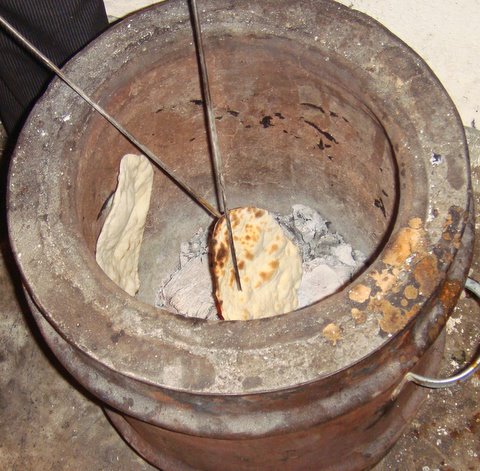
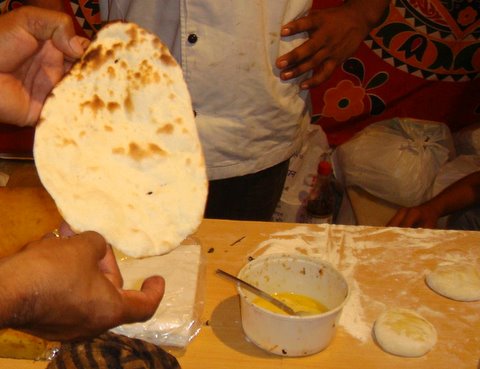
| Sheermals fesh out of a underground oven in Old Delhi! |
Apologies as over the top as the title sounds, I just could not resist it!
At the beginning of this month one of my favourite food writers, Micheal Ruhlman, announced bread baking month on his blog (Ruhlman.com). So many elements of Indian cuisine are celebrated; spices, curries, kebabs and yet, the most we overlook quintessential food intrinsic to our cuisine is overlooked, our breads. So I decided to compile a showcase of popular Indian breads for Micheal’s bread month and to celebrate today – 26th Jan India’s republic day. And almost as if the food Gods approved Vir Sanghvi’s column in Brunch last week asked the question, why don’t we celebrate our breads and our bakers. He meant the bakers in professional kitchens. But I extend that to home cook as well.
In India, we make fresh bread EVERY SINGLE DAY. I am myself, fanatic about giving my kids home-made rotis over anything else. Rotis are also very versatile; a drizzle of ghee, a smear of Jaggery, roll up and serve fresh and warm in minutes, spoon over a little subzi (vegetables), drizzle a little mayo and roll up for tiffins or layer something between two leftover rotis into an impromptu parantha somewhat like the Mexican quesadilla. Granted these are usually unleavened flat breads or crepes made of fermented batter towards the south, but they require us to knead dough or grind a batter daily. And although a lot of people in the cities are switching to buying ready flour, the majority of India still buys a fortnights worth of whole wheat, gets it ground at the local mill, and makes their dough fresh daily (sometimes twice a day).
From the poorest man who eats his roti thick and substantial, with a little chilli chutney and an onion to, the most affluent one who will have his roti light and airy with an array of accompaniments, the fact is that it is central to the Indian diet. The way they are served and combinations they are served in may change as you travel through the country, but they are the predominant carbohydrate component that fuels India. Through most of India, rice and wheat (from which rotis are made) are staple cereal grains that form the base of the Indian food pyramid supplemented by various grain and cereal flours.
Below is an overview of whatever came to mind in terms of information on breads, supplemented below by pictures of breads I have eaten and photographed in my travels around the country (more so around Mumbai). This is just the tip of the iceberg, extremely brief and lacking in proper information in many areas, but it is a start. And I have put it together based on what I had so please bear with me.
In fact I would like to invite YOU, dear reader to share your experiences of local Indian breads, their types, your memories attached to them in the comments section of this post. If you would like to share pictures, please email me at a(dot)perfect(dot)bite(at)gmail(dot)com. I will compile all of that information into another follow up post.
GYAN and LINKS
NORTH INDIA
 |
| A Tandoor or cla oven with a Naan being pulled out. |
Wheat is the staple cereal crop in the North. That said, however, Kashmir, at the northern most tip of India, subsists on rice. Although I am told there are fabulous breads to be had here, they are seldom eaten with meals. Similar to the breads of Afghanistan and Central Asia that typically accompaniments to morning and afternoon tea these are bought from local bakeries and made by professional bakers in clay ovens. Himachal and Uttaranchal use a mix of rice and bread, although the Punjabi influence of a wheat based diet is felt in both hill cuisines in the consumption of rotis and paranthas. Come down to Punjab and breads prevail. It isn’t for naught that the fertile state of Punjab has always been considered the “bread basket” of the country. Famous for its vast rolling plains of endless fields of wheat, corn and Mustard, Punjabi cuisine is all about robust daily diets of Parathas and Tandoori breads. In fact Tandoori breads could be called Punjabs legacy to the world, their hot clay bellies the source of fabulous breads such as the tandoori Naans, rotis, parathas and kulchas.
 |
| A Tandoori Naan fresh out of the oven, soon to be slathered with butter. |
 |
| A modern take on the Tandoori toti - Blue Cheese stuffed mini Tandoori Rotis at Indian Accent |

 |
| Tandoori stuffed Parantha with a mandatory stick of butter on top at a Dhaba in North India! The Tandoor gives this homestyle favourite that special oven baked flavour. |
 |
| A more modes homestyle Parantha, equally delicious! | |
|
|
 |
| The above series shows a layered roti being made by one of the ladies at the Diggi haveli in Jaipur. The dough is rolled out, laminated wth ghee, folded over, laminated again, folded over and then rolled out again. This is toasted on a flat pan, with a cloth used to press the bread down to encourage the air trapeed in the breat to heat up and puff up, cooking hte bread from the inside. |
 |
| Rumali rotis (thin breads cooked in the tandoor that come in many layers resemblin the layers oand thinness of a rumal or handkerchief. |
|
EAST AND WEST INDIA
As you head towards the east rice becomes more prevalent. The north eastern states are the least discovered part of India rotis are eaten here but rice is the staple. Bengali cuisine is also rice centric, but they do also eat flat breads such as airy Luchis and Parathas, all made of refined flour.
In the western part of India both wheat and rice are consumed, with griddle baked breads such as rotlis (thinner more delicate versions of rotis prevalent in Gujarat), theplas, dhebras, bhakris, and even parathas called bharela rotla, being eaten regularly. Some of these breads are made of wheat, but can also be made of millet flours. Maharashtra also has a host of rice based griddle roasted flat breads such as the ghavne, amboli and bhakris made not just of rice but also of other millet flours. The East Indian community indigenous to the area of greater Mumbai also makes Fritads, and Fugias, and shares a liking for sannas the steamed hand breads that goans also like with their Vindalhoo.
The Portugese in Goa, and the Parsis, Iranis and Bohri muslims in general have also contributed their share of breads to the basket, as well as kept the bakery traditions started by the Portugese Dutch and English alive. It is to these communities that we owe all of the breads we bring in from outside. Our Double roti or sliced breads, the Paos that partner a million delicious things to make cheap addictive street foods such as pav bhajji, vada pao and dabeli, and the lesser know paos such as the Brun Paos and Sheermals that are used to soak up slow cooked meat curries.
 |
| A Gujerati Thali at the Friends Union Joshi club a favourite option for the Gujarati Thali. This one features, a thin wheat chapati / rot/ rotli or phulka on the left, a spiced, Thepla with fresh fenugreek kneaded into the dough on the right and a little biscuit bhakri in the middle. |
 |
| The above series shows Theplas being made in large quantities at my mothers house by our Maharaj Chandrashekharji. for one of the lunches running up to my sisters wedding. Most Gujarati homes emply Maharajs, who are cooks of Brahmin decent and cook traditional Indian food. (Maharaj literally translates to 'king' but is the respectful way of addressing them) The dough is brocken ing little lumps, then rolled quickly into thin disks that are griddle or pan roasted and served with a smear of ghee. I love them with spicy Chunda (a hot sweet mango pickle) and hot Chai at any time of day! |


 |
| Theplas and Sukha Bataka nu shaak at Soam Restaurant in Mumbai. |
 |
| Pooris are fried breads, rolled out like rotis but then deep fried in hot oil or ghee (yes sometimes!!!) so the air trapped in them heats up and expands cooking them from the inside and puffing them up. Here they have been served with raita and Undhiyu at Soam. |
 |
| The Biscuit bhakri, a Gijarati bread that literally resemdles a biscuit, this one is made by mixing up a dough lika a pastry dough, the flour is first mixed with a fat like ghee or oil and then kneaded into a tight dough with a minimum amount of water. this is then rolled into thick biscuitlike disks and griddle or pan roasted with more ghee. Theya re flaky, buttery and delicious! |
 |
| Dal Dhokli is a delicious home style Gujarati one dish meal in which spiced rotis are rolled out and cut into diamond shapes. These are then cooked in a lentil broth called Dal like pasta untill the dough has cooked and the dal has thickened. It is served with chopped onion, ghee and lime on the side. |
 |
| The Maharashtrian trencherman's meal of Bhakri (made of rice flour ) served with a spicy chikpea flour dish called Pitla a raw onion and a Theencha which is a chutney of chillies pounded with salt. |
 |
| Bhakris being hand flattened at a seafood festival in Mumbai. |
 |
| Bhakri being cooked along with our order of masala bangda fry (makarel fried in a spice paste) at a Seafood festival in Mumbai. |
 |
| Til Polis made by the Maharashtrian community from a millet flour mix and studded with sesame seeds. This is served with Sankranti chi bhogi on Sankrant. |
 |
| A food stall at a Maharashtrian Malvani food festival stating their wares on a board; breads such as Amboli, Ghavne, Shevya Ras (noodles strained into boiling water and served with a gravy) Kombdi Vade (chicken pakoras) Jawla Pav (spicy dry prawn mash stuffed in a pav), Machi (fish) Fry and Vada Pav. |
 |
| A Ghavna being cooked at the same stall. THis is a crepe of rice flour that resembles the south Indian Dosa. |
 |
| Ambolis made of a fermented rice batter. |
 |
| The Ambolis above are similar to the Fritads eaten by the East Indain Community that is indiginous to Mumba and its ouskirts. |
 |
| Fugias, little fried batter dumplings from East Indain cuisine, with Vindaloo. |
 |
| Sannas, from East Indian as well as Goan cuisine. |
 |
| Baker in Goa's Mapusa Market. |
 |
| Local Goan bread |
| SOUTH INDIAN BREADS | |
Move South and wheat
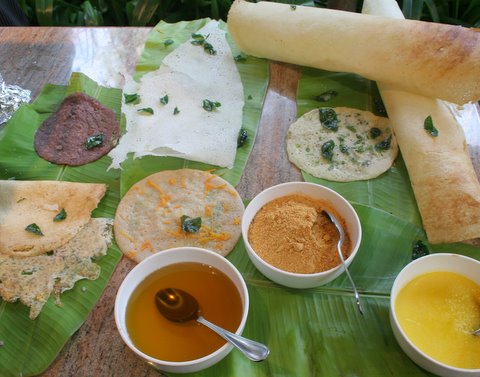
is almost non existent although there is a huge prevalence of breads, none of them are made with wheat. Instead you will find breads made of rice and rice and lentil combinations such as idlis, vadas, dosas, addais, appams, that are eaten with a variety of sambhars, chutneys and podis.
A variety of South Indian batter breads.
|  |
|
 |
| A rather dramatic flare of batter on a hot Tava! this will cook into a Dosa. |
 |
| A paper dosa, literally paper thin and crisp! |
 |
| Soft fluffy dosas for breakfast on a houseboat in kerela's backwaters. |
 |
| Little steamed idlis! |