Showing posts with label #APBCulinaryLegacy. Show all posts

Thursday, May 04, 2017

Join me on a virtual Culinary Sojourn of Garhwal with JW Marriott Mussoorie Walnut Grove Resort

Sorting Buransh (Rhondedron) Flowers. 
My fondest memories in life are centered around food and family. Alot of memories from my early life, were captured in my first book ‘A Pinch of This, A Handful of That’. But my culinary journey as a wife, daughter – in – law and mother are part of another yet to be published book on the food of Uttarakhand, filled with stories and recipes of  from the kitchen of our home in Dehra Dun, the kitchen garden and the women in my husband’s family from whom  I have inherited my knowledge.


Cooking in a Garhwali home.
Garhwali food has always been close to my heart. It is literally where my career in food began. My first piece of food writing was on on Garhwali cuisine. I am a Gujarati and I married a Garhwali. In doing so, I discovered a whole new cuisine. My pursuit of traditional recipes inspired my professional side and my eternal curiosity about cuisines, their roots, evolution, ingredients and preparations came to the fore. And I delved deeper and deeper into the history of Uttarakhand’s unique culinary culture.


So I am especially excited to share details of my latest project. This May, I am curating a Culinary Sojourn of Garhwal in association with JW Marriott Mussoorie Walnut Grove Resort & Spa. It is a unique partnership intended to promote the cuisine of a region close to my heart through sustainable tourism.

At JW Cafe
Especially now, in the present scenario of international gastronomy. Currently,  Indian Cuisine is the flavor of the moment globally and closer home, regional cuisines are gaining recognition. Globally, there is an increasing interest in food that drives the choices travelers make when planning their trips. There is also a growing segment of travelers that are interested in culinary tourism and local food and flavours.

It has always bothered me is that while the many virtues Uttarakhand’s are so celebrated, its food, which is unique, barely gets any mention – if at all. Visitors to the state would be hard pressed to find local food anywhere unless they had access to a Garhwali home. This is a crying shame because the cuisine of Uttarakhand has so much going for it!


The Garhwali Thali at JW Cafe
Thankfully, this has begun to change, thanks to the JW Marriott Mussoorie. The management of this property have been active in the advancement of Mussoorie from the very inception of the property. Some of those efforts include planting walnut groves around the property, promoting the socioeconomic well-being of the locals, generating employment, working with local cooks and food producers to learn, document and promote Garhwali food. Sunil Kumar, Directorof F&B began with employing local women to come in everyday to make fresh Garhwali flatbreads, mandue (finger millet) ki roti, gehat parathas for the breakfast buffet, growing their own produce, making their own local pickles and recently introducing their  Garhwali thali. A laudable step towards showcasing Garhwali food to their guests.

With Chandrashekhar Joshi and Ramndeep Marwah 
In natural progression came the Culinary Sojourn of Garhwal born of an idea sparked of by a simple bowl of gehat dal a year ago, between Chandrashekhar Joshi who was then GM of the property and me. And here we are! Our idea was to showcase Garhwali cuisine and culture to the world. And over the past year the team at JW Marriott Mussoorie (Sunil, Chef Sidharth, Vaidehi, Balbir) and I, with the support and backing of the new GM Ramandeep Marwah have worked together to research, document, trial and taste this cuisine  over many recces (Yep it was so much hard work!! LOL)

By the end we had put together an itinerary of unique experiences, village visits, step farming and a re-creation of Garhwali traditions and curated meals to showcase the cuisine, culture and heritage of Garhwal to food media from all over Indiabetween 29th  May to 1st  June 2017

Vendor of local ingredients
Our objective is to showcase these unexplored aspects to help boost tourism as well as to support local farmers and food producers.  Which is the other reason why I am really happy to be able to showcase Garhwali food at this point. Worldwide, there is a move toward returning to traditional foods and food ways. Slow, Organic, Local, Sustainable, Foraged are all catchwords in food trends globally. Juxtapose Garhwali cuisine against this world view and you will find that it meets many parameters of these movements in its approach to food production, preparation, diet and nutrition. In Uttaranchal, these practices are a living culture that have existed for thousands of years and where the rest of the world is trying to revive them they are living practices here. And hopefully, we will be able to showcase it all through the Culinary Sojourn of Garhwal.
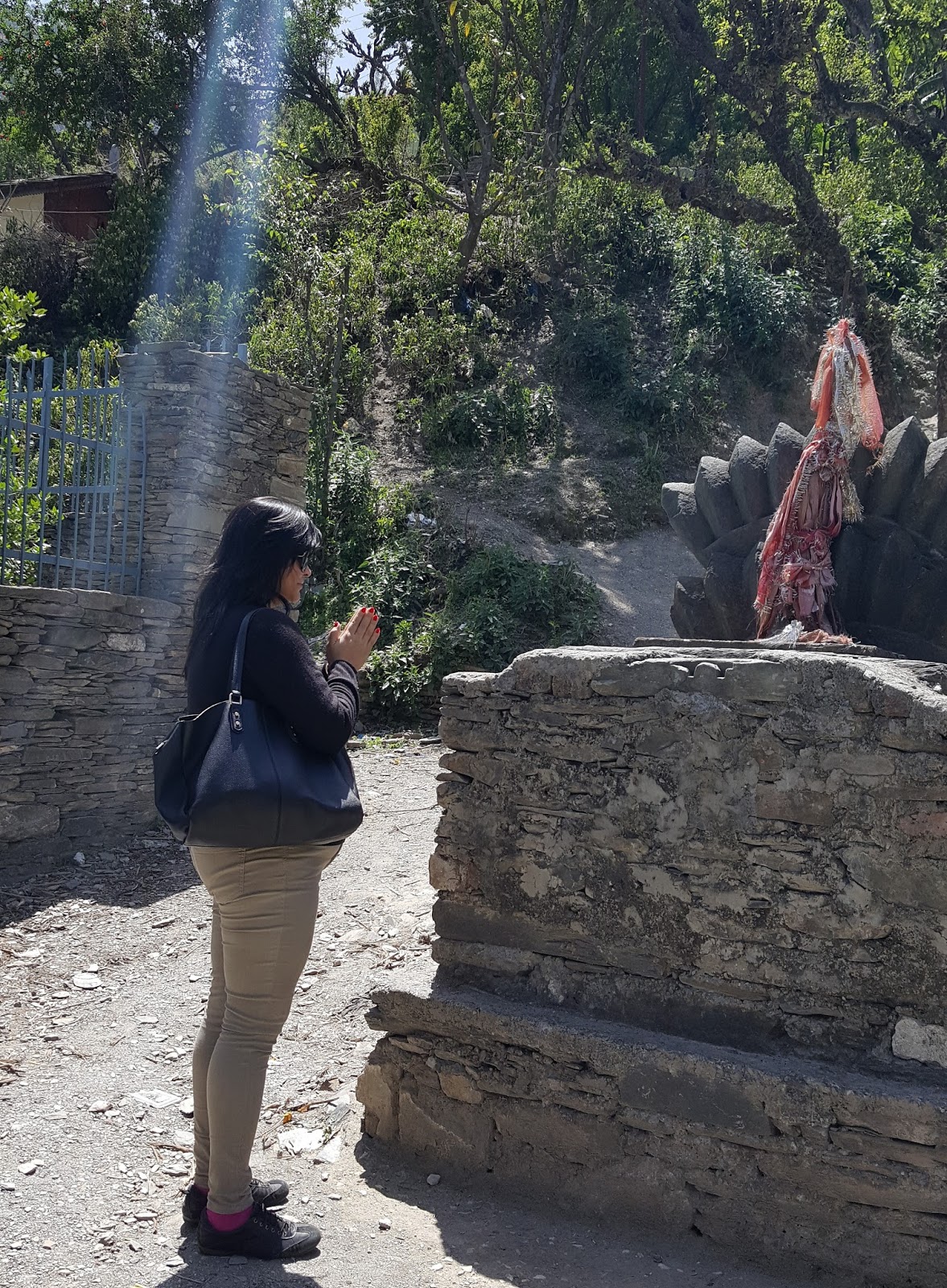
Thankful at Lakhamandal
Life has a way of coming full circle! I just realized as I wrote this post that it was in the April of 2005 that my first article  was published. 12 years down the line today, I’m still talking about Garhwali food! What a journey of discovery it has been, and I am still learning! Gratified to be able to bring together all my abilities to put this together. I have to stop to say a special thanks to Chandrashekhar Joshi, fellow lover of Garhwali food and a good friend of long standing. This could not have happened without you! You know just how much I am going to miss you! But I promise to eat extra on your behalf!

So dear reader, please follow JW Marriott Mussoorie Walnut Grove Resort & Spa on Facebook, Twitter and Instagram to #ExploreGarhwal and #DiscoverGarhwaliFood with me and a bunch of my food loving writers and bloggers. If you follow these hashtags on social media through May, you can stand a chance to win a complimentary stay at the resort by participating in the contest JW Marriott Mussoorie will run in June. Stay tuned!

Thursday, January 14, 2016

An Exploration of Garhwali Daals


 From left to right: Kulith or Gehat Daal. types of Navrangi Daal. types of Bhatt Daal, Pahari red rice, Types of Rajma, Pahari Sabut Masoor, Bhaang, Pahari Urad, Tor ki Daal, Jhangora millet. 

Above is a representation of just some of the Daals eaten in Garhwali cuisine. Summer, winter, monsoon, whatever the season, there is nothing like sitting down to a meal of steaming aromatic Basmati rice mounded on a thaali, with hot daal laddled over and a dollop of danedar, ghar ka ghee melting into glistening rivulets down the sides!

Not too many people are aware that I have been researching and writing a book on Garhwali Food for a while now. You see my husband, Shekhar is Garhwali. And years ago, when I married and discovered this relatively unknown cuisine, I was fascinated. One of my favourite things to do is culinary profiles, and writing this book has been a labour of love as well as a journey of discovery. With time, as I learned to cook it, discovered the nuances of the indigenous ingredients, and traditional practices of the culinary culture, I decided to document it. Last year, my book got into another snag in a line of many that arrested its publication. I was disappointed, but soon on the heels of that dejection came the realisation that I do not have to wait for a book to talk about the food. I can cook it for people to give them a taste of it. 

So since then, every January I carry back ingredients from Uttaranchal after our annual trip home to Dehra Dun and cook up a meal based on what ingredients I can get my hands on. Many things are not easily found so one has to go to different people and sources for them. Last year I cooked winter specials. This year, I was only able to finalise the menu the day I was travelling back, based on ingredients available little Garhwal stalls that spring up on fringes of craft melas in Dehra Dun. Yesterday I served up my latest one, titled An exploration of Garhwali Daals. 

To give you a small gist of its background, Garhwali food is the food of the Garhwali people of Uttarakhand, in North India.. Garhwalis also call themselves Paharis and their cuisine is also comonly referred to as Pahari food. However it is distinctly different from other high altitude regional cuisines of India such as Kashmiri or Himachali cuisines. Garhwali or Pahari food is not exotic, glamorous or rich. In fact it is in fact one of the simplest I have ever come accross! The ingredients of most of the dishes can be counted on both hands. Traditionally life in the hills is a hard one, so the cuisine has evolved to be quick to cook, but offers optimum nutrition, satisfaction and flavor. It is unpretentious, based on easily obtained seasonal ingredients and has distinct menus for summer and winter. At every meal food comes to the table freshly cooked, aromatic and tempting. Based on staples like Rice, indigenous millets, flat breads made of wheat flour and millet flour, that are eaten with a variety of Daals and Daal preparations that are the primary source of protein, accompanied by seasonal vegetables dishes.

Pahari food splits into two dialects — Garhwali food from the Garhwal region and Kumaoni food from the Kumaon region. Each of these community cuisines stem from the same roots and have many common dishes but with distinct regional variations, sometimes in the style of preparation but mostly based on locally available ingredients. For example while both cuisines depend on a variety of pulses for protein, Garwali cuisine leans heavily toward recipes based on Urad dal and celebrates Tor and Gehat whereas Kumaoni cuisine leans toward a predominance of Bhatt or Soya dal. 


This year, I realized that I had bought many daals. And it struck me then, that daals are the mainstay in Garhwali cuisine, so I decided to curate my menu around signature Garhwali Daals  (I have saved Kumaoni for another day.) that had been sourced from the higher reaches of the hills. Here is a small showcase of the ingredients and what I cooked yesterday though; 
Pinni ka Soup with Lehsun Ka namak ~ a Sesame broth inspired by Nani, spiked with pahadi green garlic salt.
Pinni Soup
Pahadi Namak
This is not a traditional recipe butsomething I created inspired by family stories of a Pinni ka Saag that Shehar’s Nani used to make. According to my Ma-in-law, in the old days, sesame was pressed for oil. Nani would use some of the leftover oil cake (comprising solid bits of sesame and husks) and make a saag or gravy of it that she served up with steamed basmati rice. I have never tasted this dish, but it fascinate me and I thought a thinned out version would be ideal as a shot of soup to kickstart my meal. Pahari Namak, is a flavoured salt – we use a lot of flavoured salts in Pahari food – is something we serve up with Jhangora (millet) porridge. It made the perfect topping.


Patudi with Ma's Hing ka Achar ~ griddle cakes of leafy greens with asafoetida mango pickle
Patudi are a quintessentially Uttarakhandi dish that are ubiquitous at our table when really good greens fresh from the garden are available. And the winters in Doon are perfect for this when the garden is a bounty of greens, with rye (mustard greens), fenugreek, white raddish leaves, spinach available. But they can be made at any time, really, being so quickly done. Especially good with the traditional accompaniment of Heeng ka achar (green mangoes pickled in asafeotida salt and red chillies). And I like to wash them down with Hot Chai!  


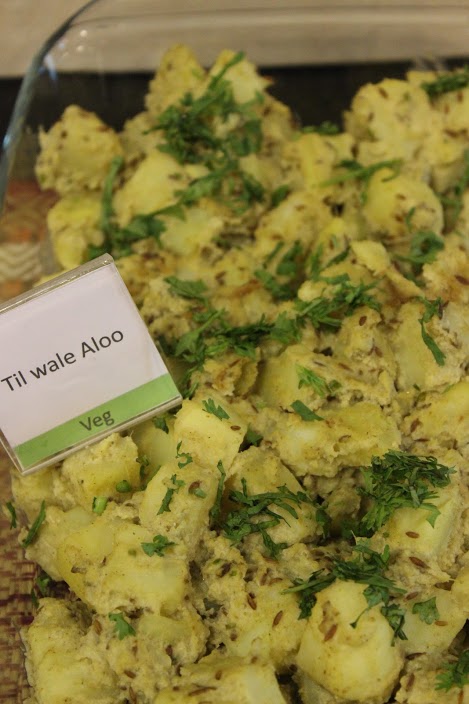
Til walle Aloo ~ Spicy tangy sesame potatoesThis is a dish Rekha Mami, Shekhar’s aunt makes for every celbratory occaision. I have been in love with it ever since the first time I had it. Potatoes tossed with Sesame paste, chillies and yogurt, it is addictive both as a chaat or a subzi.


Chawlai ki Subzi - Amaranth tempered with Jakhiya and red chillies is a popular vegetable dish. Cooked so that the onions stay crunchy. Ideal with Rotis or daal rice. 


Pahari Mooli Ki Thichwani ~ Bruised Mountain Radish and potatoes cooked with sesame
Thechwani is traditionally made using Pahari Mooli (White Radish), which is round in shape or potatoes or a combination of both. I have had this just once when one of my husbands relatives from higher up in the hills came a visiting and brought these Moolis with them. Normal Mooli or White Raddish can also be substituted. The preparation is called by this name as the radish root or potato is never cut, but crushed (thinchao) into pieces.

Pahari Tor ki dal ~ Winter special Dal of pigeon peas smoked with jambu herbs.Tor Daal is relished to the point of obsession in our family during the winter. Pidgeaon pea, this is a relative of the tur dal eaten all over the south and western parts of India, but is dried whole wiht the skin on. See how any Pahari's eyes light up at the mention of Tor Daal. 


Gehat ka phanu
~ Winter special preparation of pounded horsegram
 dal. Phanu is also made of daal like Chainsoo, but in this case the Daal is soaked in water for about 4 to 6 hours before its use. Different daals like Gahat, Arhar or green Mung can be used to prepare Phanu.


Jhangora Ki Kheeer
Bal Mithai


This event was part of the #APBCCulinaryLegacy series of events that celebrate the diversity of Indian cuisine through its home cooks.  THe series was created by Me at APB Cook Studio to preserve and propagate regional Indian cuisines that are slowly being forgotten. These events feature authentic ingredients and recipes often sourced directly from that particular region and showcased by #CulinaryHeroes/Sheroes, that are passionate ambassadors of their regional culture and cuisine. For more information please click through to www.apbcookstudio.com