Thanks to the charmed food geek life I lead, I’m surrounded
by friends and colleagues who are happy to fuel my curiosities. Recently I was fortunate enough
to get my hands on some indigenous pre-monsoon wild vegetables from the
Sahyadris, thanks to the folks at Triple OOO farms. It led to a wonderful day
of documenting the ingredients and cooking with them.
Thanks to the charmed food geek life I lead, I’m surrounded
by friends and colleagues who are happy to fuel my curiosities. Recently I was fortunate enough
to get my hands on some indigenous pre-monsoon wild vegetables from the
Sahyadris, thanks to the folks at Triple OOO farms. It led to a wonderful day
of documenting the ingredients and cooking with them.
According to traditional Indian dietetics, we eat what is in season. The cereal-pulse aspect of the Indian diet stays fairly uniform around the country. Year-round, we eat a diet in which lentils and cereals provide the bulk of meals, their repetitive monotony is made exciting by with vegetables that provide taste, texture and flavour variants to daily meals, varying according to season. With the advent of the Monsoons our diet changes.
Circumvent the carrot, cauliflower, beans offerings of the supermarket and forage through your local subzi markets. You will discover an amazing variety of seasonal vegetables. Methi is one green that is available year-round. Gourds, cucumbers, squashes also abound. As do (thanks to their hardiness) tubers like yam or suran, tapioca and bulbs like onions and garlic. And then there are the greens that come into season during the monsoons. Some for just a few days, others for the entire season. These are eaten to keep digestion sound and health optimal. As I write, the last of the Phodsi, Takla, Shevlya, are being consumed and the first of the Moras Bhaji, spiky Teasel Gourd and Colocassia are coming in.
 But for some of us who can go beyond the city, there is an even larger monsoon bounty
waiting to be discovered. Right here in Maharashtra, just a little over 2 hours from Mumbai, lie the Sahyadris, where the local tribals subsist on a diet rich
in foraged wild foods that come into season in the monsoons. Some of these such
as the Takla, Phodshi and Shevlya even make it to Mumbai Markets from Arey and
surrounding forest areas. In fact if you follow some of our local food experts
like Saee and Soumitra, and chefs like Zach you might have seen a lot of
conversations around these lately.
But for some of us who can go beyond the city, there is an even larger monsoon bounty
waiting to be discovered. Right here in Maharashtra, just a little over 2 hours from Mumbai, lie the Sahyadris, where the local tribals subsist on a diet rich
in foraged wild foods that come into season in the monsoons. Some of these such
as the Takla, Phodshi and Shevlya even make it to Mumbai Markets from Arey and
surrounding forest areas. In fact if you follow some of our local food experts
like Saee and Soumitra, and chefs like Zach you might have seen a lot of
conversations around these lately.  Foraging is a hot trend these days, thanks to Chefs like Rene
Redzepi at Noma. Closer home, Chef Prateek Sadhu is doing some very interesting work in this space at Masque. But foraged foods have always been an integral part of global
traditional food systems. I first clued into the huge repertoire of foraged foods in Maharashtra when Dr. Kurush Dalal wrote about Raanachya Bhajya (Forrest Greens or vegetables) them on his blog. And then I explored some more, realising that in India many regional cuisines supplement their
diets with foraged foods. I know Garhwali cuisine uses many foraged foods such
as wild figs, a fruit called Kaphal, stinging nettle, and fiddle head ferns.
Similarly I know that the Assamese food Gitika Saikia cooks uses a lot of
foraged foods like fiddlehead ferns, wild cardamom, ant eggs and silkworm larvae.
Things not seen in the mainstream.
Foraging is a hot trend these days, thanks to Chefs like Rene
Redzepi at Noma. Closer home, Chef Prateek Sadhu is doing some very interesting work in this space at Masque. But foraged foods have always been an integral part of global
traditional food systems. I first clued into the huge repertoire of foraged foods in Maharashtra when Dr. Kurush Dalal wrote about Raanachya Bhajya (Forrest Greens or vegetables) them on his blog. And then I explored some more, realising that in India many regional cuisines supplement their
diets with foraged foods. I know Garhwali cuisine uses many foraged foods such
as wild figs, a fruit called Kaphal, stinging nettle, and fiddle head ferns.
Similarly I know that the Assamese food Gitika Saikia cooks uses a lot of
foraged foods like fiddlehead ferns, wild cardamom, ant eggs and silkworm larvae.
Things not seen in the mainstream.  |
| Wild versions of familiar veggies, Green Pumkin, Drumsticks, White gourd (Doodhi), Cucumber, Onion, Sweet Potato, Eggplants, Okra, Bitter Gourd |
An organisation set up
by Karan and Pranav Khandelwal,
Shailesh Awate and Abhay Bhatia Triple OOO Farms work with the Adivasis of the
Sahyadris to conserve the ecosystem of their area by encouraging local farmers
to cultivate indigenous seeds and propagate holistic traditional farming
practices. Working here over the last few years, they discovered the Adivasis
have a traditional diet that is extremely high in nutrition from eating a lot
of foraged wild foods. Unfortunately as a result of commerce, unscrupulous
traders and aspirations they were losing this traditional food knowledge.
 |
| Pranav Khandelwal, Shailesh Awate and Abhay Bhatia of Triple OOO farms |
Here are some of the plants I got a chance to play with:

 Phodshi and Takla (Dont have a picture) – are available in Mumbai markets
June - end September. Both are powerhouses of minerals, vitamins and natural
anti-oxidants. They are valued for their medicinal qualities and the ability to
keep monsoon-related illnesses at bay. In fact according to Shailesh of Triple
OOO, “The Adivasis believe that these greens must be consumed when they appear
after the first rains. They are considered cleansers, that acclimatize the body
to the coming monsoon diet, and must be eaten as a precursor to all the other
monsoon produce that will come as the season intensifies. Phodshi (safed musli, mulshi, or Karli), in particular has
moist vegetal undertones, and a slight bitterness that lightens on cooking. I
first discovered it when Saee used it to make Pakodas for #ChaiPakodaDay a
couple of years ago. To prep the white bottom and central vein needs to be
removed prior to cooking. The
Aadivasis sauté it with wild garlic and onions into a subzi. It can also be
eaten raw in salads or fried into pakodas. It’s also cooked with Karandi, (tiny fresh shrimp) and Sukhat (dried
shrimp) or chana dal.
Phodshi and Takla (Dont have a picture) – are available in Mumbai markets
June - end September. Both are powerhouses of minerals, vitamins and natural
anti-oxidants. They are valued for their medicinal qualities and the ability to
keep monsoon-related illnesses at bay. In fact according to Shailesh of Triple
OOO, “The Adivasis believe that these greens must be consumed when they appear
after the first rains. They are considered cleansers, that acclimatize the body
to the coming monsoon diet, and must be eaten as a precursor to all the other
monsoon produce that will come as the season intensifies. Phodshi (safed musli, mulshi, or Karli), in particular has
moist vegetal undertones, and a slight bitterness that lightens on cooking. I
first discovered it when Saee used it to make Pakodas for #ChaiPakodaDay a
couple of years ago. To prep the white bottom and central vein needs to be
removed prior to cooking. The
Aadivasis sauté it with wild garlic and onions into a subzi. It can also be
eaten raw in salads or fried into pakodas. It’s also cooked with Karandi, (tiny fresh shrimp) and Sukhat (dried
shrimp) or chana dal.

 Phodshi and Takla (Dont have a picture) – are available in Mumbai markets
June - end September. Both are powerhouses of minerals, vitamins and natural
anti-oxidants. They are valued for their medicinal qualities and the ability to
keep monsoon-related illnesses at bay. In fact according to Shailesh of Triple
OOO, “The Adivasis believe that these greens must be consumed when they appear
after the first rains. They are considered cleansers, that acclimatize the body
to the coming monsoon diet, and must be eaten as a precursor to all the other
monsoon produce that will come as the season intensifies. Phodshi (safed musli, mulshi, or Karli), in particular has
moist vegetal undertones, and a slight bitterness that lightens on cooking. I
first discovered it when Saee used it to make Pakodas for #ChaiPakodaDay a
couple of years ago. To prep the white bottom and central vein needs to be
removed prior to cooking. The
Aadivasis sauté it with wild garlic and onions into a subzi. It can also be
eaten raw in salads or fried into pakodas. It’s also cooked with Karandi, (tiny fresh shrimp) and Sukhat (dried
shrimp) or chana dal.
Phodshi and Takla (Dont have a picture) – are available in Mumbai markets
June - end September. Both are powerhouses of minerals, vitamins and natural
anti-oxidants. They are valued for their medicinal qualities and the ability to
keep monsoon-related illnesses at bay. In fact according to Shailesh of Triple
OOO, “The Adivasis believe that these greens must be consumed when they appear
after the first rains. They are considered cleansers, that acclimatize the body
to the coming monsoon diet, and must be eaten as a precursor to all the other
monsoon produce that will come as the season intensifies. Phodshi (safed musli, mulshi, or Karli), in particular has
moist vegetal undertones, and a slight bitterness that lightens on cooking. I
first discovered it when Saee used it to make Pakodas for #ChaiPakodaDay a
couple of years ago. To prep the white bottom and central vein needs to be
removed prior to cooking. The
Aadivasis sauté it with wild garlic and onions into a subzi. It can also be
eaten raw in salads or fried into pakodas. It’s also cooked with Karandi, (tiny fresh shrimp) and Sukhat (dried
shrimp) or chana dal.  |
| Shevlya and Kakad, grow together and are cooked together. (Pic courtesy the Velkars) |
 |
| Gharbhadi |
Gharbhandi – is a creeper that is found in the
forests at this time of the year. It grows in symbiotic conditions with the
karvanda. It is cooked into a vegetable.

 |
| Pendhra |
Fiddle head ferns - are a rainy season staple in many hill
areas of India. It was pleasantly surprising to learn that they are also found
in the Sahyadris. The Adivasis there cook them into simple subzis.
 |
| Mahua Flowers - Fresh and dried |
 |
| Unripe Mahua Fruit |
Phodshi or Kauli Bhaji / Fatangadi Bhaji
 Serves 2 | Time: 15 minutes
Ingredients:
Phodshi bhaji, 2 bunches, white base and central vein removed and finely
chopped OR Fatangadi bhaji 2 bunches
Onions, 2, sliced thin lengthwise
Garlic, 4 cloves, sliced
Oil, 2 tsp
Niger seeds, ¼ tsp (Or use Cumin)
Salt to taste
Method:
Heat the oil in a pan and add the niger/cumin seeds. Once it
splutters add the garlic. When it begins to get golden around the edges, add
the onions. Saute till they begin to turn golden around the edges. Add the
chopped Phodshi/Fatangdi and sauté till wilted and bright green. Serve hot with
dal and rice or bhakris.
Gyaan and LINKS
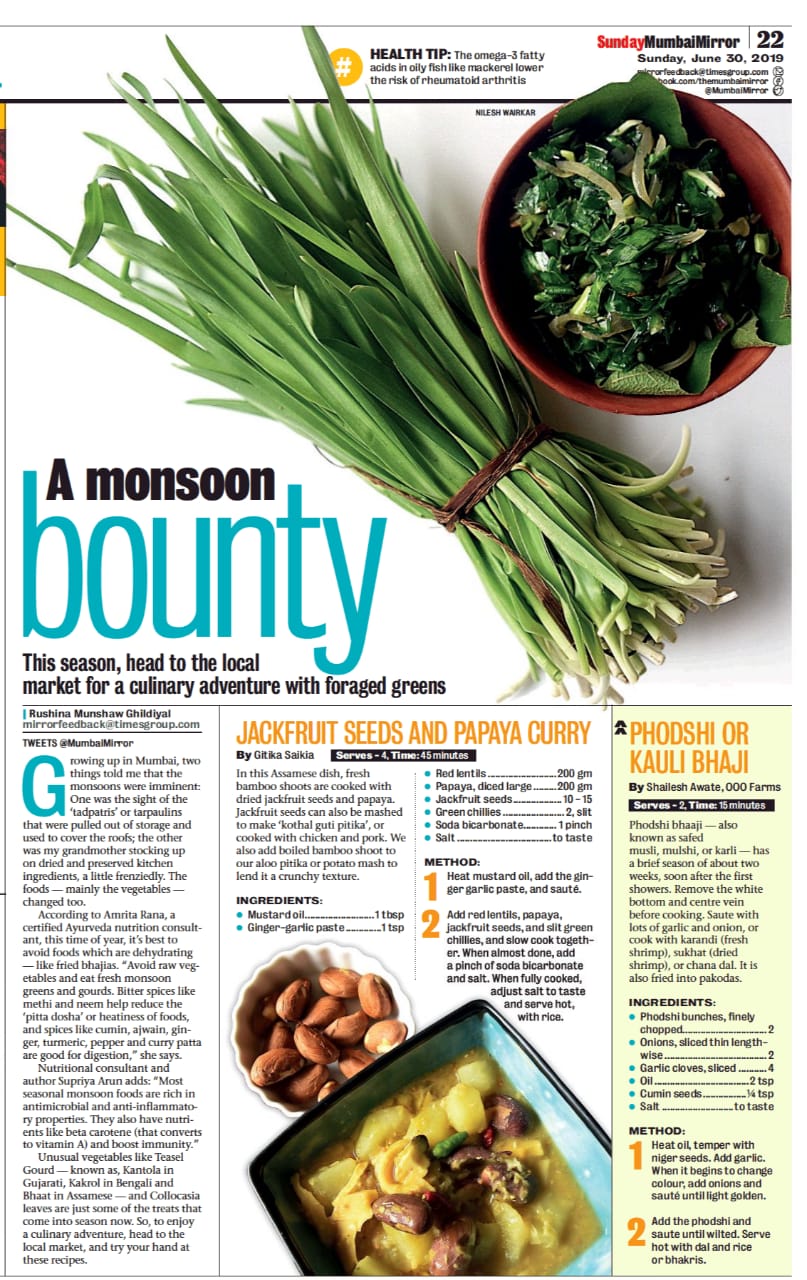
My story on Monsoons Bounty for Mumbai Mirror (featuring Jackfruit Seeds And Papaya Curry By Gitika Saikia, CKP Style Shevlya Kheema Bhaaji By Manju Velkar
Also find the recipe for Shevlya Che Sambhare by
Soumitra Velkar in this Curries for Comfort article in Mumbai mirror.
Dried Mahua is available from Triple OOO for purchase along
with a bunch of indigenous dry ingredients
(no vegetables though). Call/connect on whassap at 9116666066 to get on
their updates list) Website | Instagram | Facebook
Get a Taste of The Wild in Mumbai!
 |
| PP Prawn Curry made with Shevlya from Mumbai Curry |
Also ‘A Taste of the Wild’, is an
exciting new menu celebrating seasonal wild vegetables from Maharashtra ongoing
till 31st August at The Bombay Canteen to help create greater awareness of the
rich and diverse culinary heritage of our forests (seasonal availability of
produce means changes to the menu every 2-3 weeks but look forward to tasting
sweet Mahua Flower, salty Moras Bhaji, meaty Shevlya and more along with
cocktails like Karvanda Bramble and Wild Mahua Sour)
I will leave you all with this recipe. Would you like to experience a tribal foods meal ? I am planning a pop-up this monsoon. Leave a comment if you are interested.