Showing posts with label Full meal. Show all posts

Monday, January 10, 2011

Rushina's Recipes - Parsi Dhansak for James of the Spicery and YOU!

If you read my last post on A Perfect Bite my spice tour for James (if you haven't GO READ IT and come back), you might have noticed I made James buy Dhansak Masala and Kolahs Vinegar at Motilals with a promise to send him the recipe. And then I realized that it is the perfect dish to cook up on these horrid cold cold days we are having so I thought I would put it up here for you and James.  


Although Dhansak is a very homestyle meal, it was my first ever taste of Parsi food and has stayed a favourite comfort food ever since. When I was a boarder (at Mayo girls in Ajmer) I looked forward to outing Sundays when my local guardian Gul Marfatia would come take us out for the day. The collective illusion we students liked to live in at the time was that we were imprisoned in MCP (Mayo College Prison)! Deprived of freedom, tuck, meeting boys… you get my drift I am sure…

So you can imagine what a highlight it was to visit Gul Aunty on our monthly outing Sundays. The patterns of these visits typically began with us spilling into her house and settling down in various sections of it as Kishan, their house keeper and long time retainer came around with a tall glass of chilled Lemon Barley water (a local brand that we still ask for from people visiting Ajmer) to tide us through the hungry minutes until lunch was laid.

The Parsis are a community of Indians decended of Persian Zoroastrians that immigrated to the Indian subcontinent over millennia ago, fleeing persecution by the Turks. A rather charming legend attached to their arrival has it that when they arrived on the shores of Sanjan in Gujarat the sent an emissary to the local ruler for permission to settle there. He replied by sending them a brimming glass of milk to illustrate that there was no space for them and diplomatically turn them away. The Parsis replied by stirring in sugar and returning the glass indicating that they would assimilate into the culture of the country very smoothly. Just like the sugar dissolved in the milk without the glass overflowing. The Rana was convinced and the community made India its home. And not only did they assimilate into the country, they enriched it like sugar enriches milk, contributing to the culture and development of India in a multitude of notable ways, over the ages, not the least of which was with their food.

Food is intrinsic to Parsi culture and a richly layered cuisine has evolved over the years. Into the intrinsic richness of traditional Persian cuisine that they brought with them, rich with dry fruit, nuts, rose water, a proclivity toward pilafs and dishes that combined meat and vegetables were stirred the seafood, vegetables and coconut and spices that were the mainstays of the local Gujarati and Maharashtrian cuisines in their new home country.

But the Sunday lunch at Gul Aunty’s was always Dhansak, which is the name of the main dish as well as the whole meal built around it. Dhansak is not a festive dish. It is actually served when a family is coming out of mourning. But it is also often served as a special Sunday meal mandatorily washed down with a chilled beer or two and followed by a long snooze. Centred around a stew of meat cooked with lentils, vegetables and Dhansak masala and simmered until the lentils and vegetables have disintegrated and the meat is falling off the bone, Dhansak is traditionally served with caremelised brown rice, kachumber and kebabs or fried meatballs (wether you do all of that is up to you). The meatballs are usually made of Mince meat, but I could not get that the day I made it.

Dhansak Recipe Time: 1 hour 20 mins, Serves 6
This recipe is a combination of the recipe my friend Kalyan of the blog Finely chopped shared (It is Mammas his wife’s grandmothers recipe), the recipe Kishan shared over a busy phone line for Dhansak made in Gul Aunty’s house and a few adjustments to the whole made by me to match my memory of how it tasted. The cachumber of finely chopped onion, tomato and coriander distinctively flavoured with Kolah’s vinegar, the sugarcane vinegar that is characteristic to Parsi cuisine which helps cut through the meatiness of the dal.

For the Dhansak
500 g mutton/chicken
125 g Tur daal
2-4 small brinjals quartered
1 c pumpkin chunks
1 onion diced
1 large potato, cubed
1 tsp methi seeds
3-4 tsp Motilals Dhansak masala
1 tsp turmeric powder
1 tsp chilli powder
1.5 teaspoon ginger garlic paste
Salt
1.5 tsp ghee
2 tablespoons chopped coriander leaves

Method:
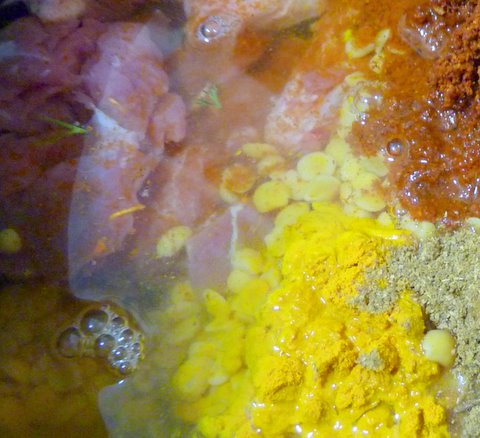
Wash and soak the toor daal for half an hour in two cups of water in a large preasure pan, then add the cleaned mutton, vegetable and all the spices to it. Place on a flame and heat. When it comes to a boil cover cooker with the cover and shut. Cook on a high flame until the cooker has whistled thrice. Then lower flame and cook for half an hour after that. Resist the temptation to open the cooker until it cools and the preassure is released. The dal and vegetables should have disintegrated completely or at least be cooked to a mush and the meat should be falling off the bone. Add a bit of water to loosen the daal if required and churn with a wire whisk so only the mutton pieces remain whole. Add coriander leaves and allow the mixture to simmer for five minutes stirring gently so no lumps are formed. Add the butter or ghee in, take off flame and leave dhansak covered for five minutes so that all the flavours infuse in.

For the Caramelised rice or Vagharela chawal
2 ½ c rice
2 onions, sliced
2 " cinnamon stick
8 cloves
6 cardamoms
salt to taste
2 tbsp ghee

Wash and soak rice for 20 mins, drain and keep in a strainer for another 20 mins. Heat ghee add spices and then onions and fry till onions are well browned. Add the washed rice and salt and saute for 3-4 mins. Add boiling water to cover rice (by an inch). Bring to boil and then lower heat and simmer with the pan half covered till holes appear in the surface. When water has more or less dried out, cover completely and lower flame so steam can build up in the pot. Put off flame after 5-6 mins and allow the rice to steam cook till done.

For the Kachumber
The kachumber consists of onions tomatoes, cucumbers, corriander and green chillies chopped fine, mixed together mixed together. Salt and lemon juice are added and the whole is set aside to marinate in its own juices.

For the Prawn Kebabs (Kolmi Na-Kevab)
300g Prawns, shelled and deveined
1 tsp Cumin seeds
2-3 Green Chilies, finely chopped
1 onion, finely chopped
1 head garlic, finely chopped
1 tbsp coriander leaves
Turmeric powder 1/2 tsp.
Worcestershire sauce 1 tbsp.
Egg 1 no.
Oil For deep frying
Salt and pepper As per required

Wash and season prawns with salt and rset aside for atleast 30 minutes. Then wash again and pound or whizz coarsely in a blender. Add them and the rest of the ingredients except the eggs to mortar or blender and pound or pulse again until well blended but coarse. Knead in the egg and make into small balls. Deep deep fry for 6-10 minutes, until golden brown. Serve hot.


Wednesday, February 10, 2010

Tofu tips, tricks and recipe forTofu and Sprout soup from my Demo at Nature's Basket!

Tofu

While I was demonstrating my Tofu and Sprout soup at the first of Nature’s Basket’s Savor Life series of workshops this Tuesday, I couldn’t help remembering my first experience cooking Tofu. I added it to Thai curry but was unable to get rid of that calcium flavour that tofu inherently carries. I was defeated by that seemingly harmless looking block of tofu and convinced myself that cooking tofu at home was risky business I will never attempt again. Until I tasted the Clay pot braised bean curd with chilli and mushrooms at China House. The succulent chunks of tofu, slightly crispy on the outside, meltingly soft on the inside in their caramelly spicy savoury sauce… awakened me to the potential of tofu.

A little research (thanks to the www) and I figured out where I was going wrong but before that let me run you through a primer on tofu. Called Tofu in Japanese, doufu in Chinese and bean curd in general, tofu is an ingredient that originated in China through a process that is about 5000 years old. Tofu is basically soymilk curd made by coagulating soy milk (much like cheese or paneer) in which the resulting curd is pressed into blocks. Tofu is celebrated for the health benefits it imparts; a great source of high-quality protein, rich in B-vitamins, iron and an excellent source of calcium. Research has also found that people with diets high in soy have significantly lower rates of heart disease, osteoporosis, cancer (breast, colon and prostrate) and fewer menopausal symptoms thanks to disease protecting qualities derived from "isoflavones" found in the soy based foods.

So it’s not surprising that this relative newcomer to the Indian Kitchen, that is now widely available all over the city, is used as a healthy substitute for other ingredients such as paneer in Indian dishes and cheese in Italian ones. But the fact is (and I have concluded this after much trial and error) tofu can be savored for
itself.

There are several types of Tofu available, your selection will depend on the dish you are making. Firm tofu is solid, holding up well in stir fry dishes, soups, or on the grill – good for anything that requires rigorous cooking. Soft tofu is best used in recipes that where it is added as is - oriental soups, or dishes that require minimal cooking - because it is delicate and will fall apart easily. Silken tofu is the softest option available with a creamy, custard-like product texture that works best in pureed or blended dishes like dips, dressings, sauces and desserts. Rule of thumb I use when a recipe does not specify type is to use firm Tofu.

When buying Tofu keep in mind it is perishable, so buy only as much as you need, check expiration dates and avoid damaged or puffy packets. On opening check that it is not moldy, filmy to the touch, smelling or tasting sour, sharp, or biting. Store leftover, uncooked tofu covered with fresh water and change the water daily to keep it fresh. (I freeze extras in an airtight bag or container.). Use open Tofu within
2-3 days. Freezing is another way to both store and dry out tofu (It will turn yellow but will become white again on thawing.) Freezing changes tofu's texture, toughening it and the subsequent thawing makes it more, chewy and absorbent so it soaks up marinades and sauces better. To thaw tofu quickly, microwave on a paper towel or boil for a few minutes otherwise leave out in a colander under a weight.

Cooking with tofu is easy, with little flavor of its own, like a sponge, it will pick up the flavors of whatever ingredients it is cooked with. Mash, blend, whip, grate, grind, crumble, marinate, simmer, steam, bake, broil, sauté, barbecu, fry, you can do anything you want to Tofu. The key, to cooking it right is in its handling. Drain it well, marinate it and seal in flavours before adding it to a dish

What I was doing wrong earlier was opening the packet, draining, chopping and adding it to my dish like I would paneer. What I should have been doing was discarding the liquid and draining or pressing the tofu. (To remove any residual calcium flavor, I go one step further, rinsing tofu with fresh water). Then either leave tofu to drain in a colander or wrap in a clean absorbent dish towel and weigh down for about 30 minutes. I find this method prepares tofu best for it absorbing the falvours from marinades.

Marinating tofu is the best way to flavor it. Again if a recipe instructs you to marinate tofu without specifying texture, I recommend using a regular firm or extra-firm tofu. When your marinade is thin, you need only to quickly dip the tofu in it for it to be fully absorbed but with thicker marinades you might have to leave it in for several hours or overnight for full absorption. If marinating for less than an hour, leave at room temperature turning occasionally, however for longer periods place in a tightly-covered container in the refrigerator to prevent spoilage.

Tofu acts like a sponge as I said earlier literally. Initially I would go through the time and effort of draining and marinating and still find flavors lacking after I added it to my dishes, especially soups or stocks. Because the tofu "sponge" absorbed any liquid, in this case it drastically diluted the flavours from the marinade and returning the tofu's firmness to its original state. The trick around this is to "lock-in" the flavor. Once marinated, strain out, lightly pan fry or
broil and add to dish.

I know this might sound like a lot of trouble to make an ingredient palatable but there is no excuse for eating boring food. Introduce tofu to your table, not as a fake meat or cheese but as a valued ingredient that tastes good and is good for you!

Tofu and Sprout soup
This recipe is anchored on the flavour of pure vegetables. Bits of Tofu add texture and sprouts offer healthy crunch and fortification.
Serves 4-6
Time 45 mins
1 tbsp olive oil
1 c carrot diced
1 c onion diced
1 c white gourd diced
1 tsp ginger grated
1 ½ l homemade dal, vegetable or chicken stock
2 tbsp chopped fresh herbs
1 cup sprouts
1 cup tofu diced
Sliced lemon
Over moderate heat, cook all vegetables in the olive oil until soft. Add stock, ginger, bay leaf and tofu. Bring to a boil. Taste for seasoning. Ladle into soup bowls or mugs, top with herbs, a handful of sprouts and a slice of lemon and serve.
------------------------------------------------------------------------------------------------------------
Links and GYAN
Tofu is available all over Mumbai, Nature's Basket carries a large seection. Other recips with Tofu - Colorful marinated Tofu stir fry
For those of you that havebeen writing to say you wished you could have come,
16th Feb 2010 (Tuesday) I will be a Natures Basket Warden Road between 05:30 – 07:30 PM
20th Feb 2010 (Saturday) I will be at Natures Basket Bandra between 01:30 – 03:30 PM.

Colour full marinatedTofu Stir fry


Marinated Tofu Stir Fry
Serves 4 Time 30 mins

To Marinate Tofu
½ cup soy sauce
½ tsp sesame oil,
Rice wine vinegar, to taste (or small amount of synthetic vinegar)
6 cloves garlic minced
½ tsp red chilli flakes
1 block of Firm or Extra Firm Tofu

For the stir fry
¼ cup sesame oil
6 cloves garlic sliced thin lengthwise
1-2 green chillies sliced lengthwise
1 inch piece ginger sliced thin diagonally
1 carrot julienned
1 cup baby corn sliced diagonally
2 stalks celery (bias cut)
Medium size red and green peppers 1 each (julienned)
1 medium onion (julienned)
1 cup fresh brocolli florets
1 cup fresh bean sprouts
1 cup spring onion greens cut into one inch pieces
1 stock cube
2 tbsp water
½ tsp cornflour to finish (optional)

Squeeze and drain tofu and cut tofu into ½ inch by 1inch pieces. Place all the marinade ingredients together in large bowl and mix well. Toss tofu in the marinade and allow to stand for at least 30 minutes or overnight tossing once or twice if possible. To make the stirfry heat a wok to medium-hot, and add oil, strain out tofu pieces from the marinade and stir-fry for 2 minutes (reserve marinade for sauce). Remove tofu and set aside on a plate. Add the sliced chillies, garlic and ginger and stir fry for I minute until fragrant, add carrot and baby corn and stirfry for 1 minute, add celery and stirfry for I minute. Add Brocolli, sprouts and fry another minute. Add marinade, stock cube, salt and pepper to taste and a 2 tbsp water if required cover and bring liquid to a boil. Uncover add onion greens and stir well. Dissolve cornflour in a little water and add to the stir-fry, mix well and allow to cook till the gravy has thickened and coats vegetables a little. Serve over hot rice or rice noodles
Posted by Picasa

Saturday, August 15, 2009

The Thali in regional cuisines of India


Thali
Today is the 15th of August and foodie real estate across the board is in patriotic fervor of serving up food in saffron white and green hues. It’s a trend that I shudder at. I am all for the golden hues of saffron feathering out in a dish, the balance that cereals bring to our diet and the importance of greens on the plate but I draw the line at color coding my food in celebration.

Flu (not the dreaded swine flu but the equally painful normal one) raged rampant in our home last week and beyond home walls, the country seems to be facing many ills; drought, swine flu and a million lifestyle diseases, I am more and more convinced that we need to return to traditional diet and cuisine practices. And then in all this strife comes the good news. My sister, the baby of the family will be getting married this December.
So today, I would like to celebrate something as unifying (and perhaps as colorful but in a far less shudder inducing way) as our national flag, the Thali. That every day meal so named because of the plate it is served in. But in its very unity is its diversity, because as you travel around India and you will find every regional cuisine boasts its own version.
It seems appropriate to celebrate the Thali, since we Indians have an innate sense of hospitality, stemming from the essential role food plays at religious and social gatherings in our lives. Beginning with the first sip of water proffered to an arriving guest continuing into as lavish a spread of food as the host can afford, winding through delectable desserts and concluding with a selection of mukhwas and paan. The Thali is not just a meal, neither is it just a utensil, it is in fact, a tradition.
Nowhere in the world do the rituals of a wedding compare with those in India. With myriad gods and an equal or more ways to praise, petition and appease them, the sense of pageantry is inherent in every Indian. Of course no celebration in India whether in celebration of initiation or naming ceremony, religious ceremony or wedding is complete without food! Indians will never miss an opportunity to bring colour into their lives so why should weddings - viewed as the union of two families more than individuals – be left out?

Food is integral to the Indian lifestyle. At any Indian wedding, holding its own amidst the pomp, pageantry, rich apparel, music and dancing is the delicious anticipation of the traditional wedding feast. The work area for a wedding feast is wondrous to behold, a large area is designated for cooking within which a mobile kitchen is set up and before you can blink, each aspect of the feast has a specific area and production has begun in earnest vessels of colossal sizes that bubble and boil with all manner of delicacies under a heady cloud of aromas. The waiters or serving staff know where to refill each dish and play their role of keeping the groaning buffet tables teeming with food.

A while ago I had done a story for an airline magazine on wedding feasts from around the country. Here are a few highlights. The Southern part of India is not represented here, but I hope to redress that soon.

Kashmiri Wazwaan An important part of the ancient silk route and home to the most expensive spice in the world, Kashmir’s geographical location and historic position have led to it being home to a bounty of produce and resulted in a cuisine that is a happy marriage of spices, meat and dairy produce, augmented by a wide variety of vegetables and a veritable orchard of fruit. Although daily meals in Kashmir are not so elaborate, the Kashmiri Muslim “Wazawaan” an elaborate ritualistic meal for special guests especially at weddings is legendary. Do not make the mistake of declining an invitation to one. These meals prepared by Wazas – master chefs of Kashmir descended from chefs that served the Mughals - are nothing short of spectacular. Comprising of upwards of thirty or more courses of specially prepared meats and vegetables, dishes to look out for include; Rogan josh a meat curry red with Kashmiri chillies, Yakhni a meat dish cooked in delicately spiced yoghurt, March wangan korma a chilli mutton curry, Daniwal korma a superbly tender meat on the bone the delectable Tabaq Maaz unspiced rib cuts fried to a crisp, Rista balls of pounded mutton cooked in a gravy, Gushtaba pounded meatballs cooked in yoghurt. The meal concludes with the Gushtaba, a very exclusive dish, and one that is never refused, Phirni for dessert and a cup of Kahwah, the green tea flavored with saffron, cardamom and almonds, and the wazwan is over - a meal that is an experience in Kashmiri hospitality. There are very few desserts Phirni is a rice cream delicately fragrant of rose water, Shufta a stew like concoction of cottage cheese and dryfruits in syrup and Modur Polav, a sweet rice dish cooked in clarified butter, milk and water, along with dry fruits, saffron and fragrant with spices - a favourite dessert of Kashmiri Pandits.

The Gujarati Thali - Often referred to as haute cuisine for vegetarians the bright, colourful festive fare from Gujarat is delicious. The Gujaratis have truly perfected the art of vegetarian cooking. Even the simplest of ingredients are transformed into mouthwatering delicacies. The Gujarati 'thali', is an endless procession of fresh vegetables cooked in aromatic spices, a variety of crisp, fried snacks and an array of delectable confections typically appear in the 'thali'. Gujarat is known as the land of milk and butter. Obviously so, yoghurt and buttermilk are a part of the daily diet. Offerings include Khaman Dhokla lightly steamed spongy yellow lentil Khandvi silken gram flour rolls flavoured with buttermilk Patra pinwheels of Collocasia rolled with a lentil paste, steamed and fried. Main course specials that cause nostalgia with mere thought of them include Undhiyu an aromatic medley of vegetables with fresh green garlic slow cooked on a wood fire. The sweet hot Gujarati daal best enjoyed with steaming hot rice & a dollop of clarified butter. There are a plethora of sweets that are served alongside the savoury including halwas and the delicately scented Shrikhand made of thick creamy sweetened natural yoghurt.
The Lagan nu Bhonu or Parsi Wedding feast - Parsis are a very intellectual, talented community that came from the area that was formerly Persia and is now Iran. They entered India through the state of Gujarat and contemporary Parsi cuisine is a tantalizing marriage of Persian and Gujarati styles; like the nuts and apricots they added to the Indian curry, they stirred the richness of Persian cuisine into unassuming Gujarati food. Very rarely chilli hot Parsi cuisine is a complex blend of flavour and texture with a partiality toward chicken, mutton and eggs. Parsee weddings are joyous celebrations full of tradition and joyous feasting. Long white linen covered tables stretch the length of the dining hall and dinner is served in 1 or 2 seatings. The actual meal is served in numerous courses on a fresh banana leaf with fish, rice and meat delicacies accompanied by classic desserts including Lagan Nu Achar (a hot sweet pickle, Kolmi na Kevab - Crisp fried shrimp kebabs, Marghi na farcha - chicken marinated with chillies, garlic and coriander and pan-fried in an egg coating and Kheema Pattice - minced lamb aromatic with spices and encased in puff pastry served with a sour-sweet tomato sauce. Mains would include Patra ni Machchi - fish marinated in spicy green chutney and steamed in banana leaves) and/or Saas Ni Macchi - fish in tangy white gravy, seasoned with coriander), Sali Chicken a chicken curry served with salty potato sticks Kid Mutton and Pulao Dal A must dessert is the Lagan nu Castard –a rich creamy egg nut enriched custard flavoured with nutmeg.

The Marwari Thali Rajasthan being largely a dessert area, makes the best of what it can get, even in its cuisine. Kair (capparis decidna) are the small green berries found in the dessert, that usually cooked as vegetable or pickled with Sangri, slender green pods that appear on the khejri (Prosopis cinararia) during the blazing months of June and July, (the root system of this plant go seventy feet deep, allowing it to withstand years of complete drought). Marwaris, Have a rich diet and also subscribe to the precepts of the Jain diet. Dried beans and spices such as aesofoetida, dried mango powder, red chillies, mustard seeds and dried oods such as 'papads' and 'badis' form a large part of Rajasthani cuisine as these have a longer shelf life and proved to be very useful in the early days when there was little produce in summers and transport was not so efficient. There is a minimal use of fresh vegetables because Rajasthan is a dry region. Marwari cuisine uses a lot of lentils and spices and whatever little veggies are available are dehydrated and stored for use round the year. Most Marwari food can be preserved for long periods, having evolved from the Marwaris who are essentially traders, having to travel long distances and needed to carry food So with Marwari cuisine the "Raita" is sans vegetables and vegetables like "Gatte Ke Saag" have been created, made of chickpea flour and "Dal Ki Belvi Poori" with only lentil stuffings. Yoghurt is used in good measure, for it’s coolng properties and chillies are favoured to add zing to the food. Rice is considered a delicacy in Rajasthan as it does not grow here. Besides the Ker Sangri, a Marwari thali could offer choices such as Chaats, Gatte ke Saag, Zari Palle Ka Choorma, Dal Ki Belvi Poori, Ghee Bhaat, Bhutte Moongdal Ki Pakori and Raita made of Phogle seeds.

Bengali Bhojon
Bengal has long been cited as the land of plenty and so it should be. After all, it IS the only state in India that extends from the majestic Himalayas in the north to the Bay of Bengal in the south. Fertile lands, innumerable water bodies and a large coastline make the land truly blessed!
Bengali food is the only cuisine in India that is served coursewise. Food is traditionally consumed sitting on the floor on mats or Aasans. In front of each Aasan is placed a large platter fashioned out of bell metal/steel or a large section banana leaf. Around this platter are positioned a number of small bowls in which portions of dal, vegetables, fish, meat, chutney and dessert will eventually be served. Rice enjoys the pride of place in the center of the platter flanked by vegetable fritters, wedges of lime, whole green chilies and perhaps a bit of pickle. The piece de resistance is little hole in the middle of the mound of rice that is topped up with a spoonful of ghee!

Whatever the number of dishes the most important part of eating a Bengali meal is eating each dish separately with a little bit of rice in order to savor its individual flavors. The order of consumption goes from the more delicately flavored dishes first and slowly graduating to stronger ones. Vegetables, especially bitter ones, come first, followed by dal, perhaps accompanied by fries or fritters of fish and vegetables. Then come complex vegetable dishes like Ghanto or Chachchari, the important fish Jhol as well as other fish preparations in that order. Meat will always follow fish, and chutneys or ambals will provide the refreshing touch of tartness to make the tongue anticipate the sweet dishes.

Bengali food is a revelation for the uninitiated. It is a fusion of textures - Crisp bhajas, grainy mustard sauces, oily fish head biting into juicy prawns - and a tactile feat of picking one's way through fish bones to get at spicy, delicious bits of Ilish, (chewed fishbones are proof of an authentic Bangla meal), thin, light Luchis that put Puris to shame. And then there is Panchphoran! The five-spice mixture that is the mainstay of Bengali food. Rice is the staple, and cold pressed golden mustard oil is the pungent Bengali cooking medium. The “ranna-ghar” or cookhouse is the centre of the Bengali home. It is here that the magical meals are conjured out of mere ingredients! Preparation for each dish is elaborate, with emphasis being laid not only on freshness but also how certain fish and vegetables are cut. Spice combinations are precise and each dish is individually made. In more orthodox Bengali homes, fish and vegetables might still be cooked over separate fires and lamb, if cooked is done on a makeshift fire outside the kitchen.
Everything is eaten with the fingers. What better tool for the dangerous task of picking out treacherous fish bones? The textures of the food are appreciated first by the fingers and then enter the mouth. The other notable factor about Bengali eating habits is the amassing of miscellaneous debris by the plate. Vegetable stalks, fish heads, meat, fish and chicken bones, are all meticulously chewed to extract every last drop of flavor prior to being added to the heap with accompanying sounds of chomps and slurps (a measure of the quality of the meal) and a great burp as the crescendo!

Thalis in Mumbai

The Rajasthani Mahila Mandal Griha Udyog stock kair and sangria. Rajasthani Mahila mandal bhavan, 12 Krantiveer Vasantrao Niak Cross lane (Forgett St.) Near Sai Baba Mandir, Gowalia Tank Mumbai 36. (23873197)

Chetana Veg Restaurant and Bar 34, K Dubash Marg, Kala Ghoda (2284-4968). Daily 12.30-3.30pm, 7.30-11.30pm. Gujarati thali Rs 210, Rajasthani thali Rs 270, health thali Rs 230.

Friends Union Joshi Club 381A Kalbadevi Road, Narottamwadi (2205-8089). Mon-Sat 11am-3pm, 7-10pm; Rs 70 plus Rs 15 for an optional sweet. Sundays and holidays 11am-3pm, Rs 90.

Panchvati Gaurav Near Bombay Hospital and Metro Adlabs, Marine Lines (2208-4877). Tue-Sun 11am-3pm, 7-10.30pm; Mon 11am-3pm. Rs 170 from Mon-Sat. Rs 200 on Sundays and holidays.

Rajdhani 361, Sheikh Memon Street, opposite Mangaldas Market, near Crawford Market (2342-6919). Daily noon-4pm, 7-10.30pm Rs 152 from Mon-Sat. Rs 191 on Sundays and holidays.

Samrat Prem Court, Jamshedji Tata Road, Churchgate (2282-0942). Daily noon-3.30pm, 7-10.45pm. Gujarati thali. Rs 141 (lunch) & Rs 175 (dinner) on weekdays; Rs 174 on Sundays and holidays. Prices are inclusive of taxes.

Swadshakti Ayushakti Ayurved Health Centre, Bhadran Nagar Cross Road 2, off SV Road, opposite Milap theatre, Malad (W) (2806-5757). Daily 11am-9.30pm. Special thali, Rs 80 (limited) & Rs 100 (unlimited).
Posted by Picasa

Friday, January 04, 2008

A Chindian meal

There is no authentic version of the Chinese food we eat in India, so do not go to China expecting to eat Manchurian, Chilli chicken, Hot and sour soup or any of the dishes that we Indians love as Chinese food. However Indian Chinese or Chindian is a delicious addictive cuisine in itself. Here is a favourite meal of ours.
Mushrooms and Chicken in Black bean sauce

Ingredients

500 gms chicken breast - cut in 1/4" strips
2 tbsp rice bran oil (I use Tandul)
500 gms mushroom - Quatered
4 tbsp black bean garlic sauce (I like Lee Kum Kee Spicy blak bean sauce best)
2 teaspoons cornflour

For the Marinade
2 tbsp soy sauce + 1 tbsp vinegar and 1 tsp sugar OR 3 Tbsp Chicken Marinade from Lee Kum Kee
1 garlic clove - minced
2 teaspoons fresh ginger root - grated
2 red chiles - thinly sliced (optional)

For the Marinade
In a bowl, combine LKK Marinade or soy sauce, vinegar and sugar with the garlic, ginger and chillies, stir well and add chicken. Leave for 1 hour. Remove chicken from the bowl with a slotted spoon and to the marinade left behind add the stock or Maggi cube mix. Stir well. Set aside.

Method
In a wok or large frying pan, heat sesame oil over high heat. Add chicken and stir fry till lightly browned (3 minutes). Add mushrooms, and allow to cook till they release juices. Continue to stirfry till juices from the mushrooms have evaporated and they are slightly brown in patches. Now add the black bean sauce and stock-marinade mix and let them warm through. In a small cup, stir the cornstarch together with a little cold water. Pour this into the pan and cook, stirring constantly, until sauce is thickened.

For a vegetarian option double mushrooms and substitute Chings secret all stir fry sauce for Chicken marinade.

Stirfry of Jullienned vegetables

Ingredients
2 tablespoons oil
1 ½ cups carrot juliennes
1 head Broccoli Florets (set florets aside and julienne stalks)
1 cup french bean juliennes

Method:Put Wok on the flame and let it get hot. Add oil, swirl once to oat the base and add in julienned carrot, beans and broccoli stalks - in that order - stirring briskly all the time. Cook for 2 minutes. Add Broccoli florets. Splash 2-3 tablespoons of water into the wok. (This should really steam up the kitchen if your wok is hot enough). Toss vegetables well. Salt just before you serve.

Celery and Spring Onion Sticky rice
Ingredients
2 cups short and fat grained rice ( I like Kolam)
5 – 6 cups water
2 tsp Massels stock owder (I imort this from Australia but you can use Maggi Chicken or vegetable stock cubes in a pinch)
1 tbsp oil
1-2 whole red fresh chillies or some Chilli oil (optional)
½ cup garlic, chopped fine
1 cup celery sliced fine
2 cups spring onion sliced fine

Method
In a large deep pan place water, rice and stock cubes. Bring to a boil and simmer until rice swells, at this point take of ¼ cup of the cooking liquid and set aside. Let rice cook till all of the water is almost absorbed and switch of flame. Cover and keep till ready to serve. In a frying pan add 1 tbsp of oil and heat, add chopped garlic and sauté for a while until the edges start to get golden, add in the celery and stir well. Add the reserved cooking liquid from the rice and the spring onion and stir well. As soon as the spring onion starts turning bright green, take pan off flame and set aside and stir in salt to taste.

To serve pack rice tightly into a large 250 gm measuring cup and ease onto the plate, spook some of the Celery spring onion mix on top of the rice and top with a couple of chillies or a drizzle of chilli oil. Arrange the other two dishes around the rice and serve.


Posted by Picasa