Showing posts with label Indian Food Observance Days. Show all posts

Monday, October 09, 2017

Mark #LadduDay and World Food Day by distributing Laad Ke Laddu to address hunger and Malnutrition


I am a little late on this one! Between all the stuff that we had happening for Chutney day and preparing for the upcoming festive season, its been a bit crazy. BUT we have all been so enthusiastic about celebrating the food observance days until now, i am hoping the subject of the next one will charm you into joining me in spite of the delay in announcing it. 

Because the next day we are celebrating is one that is close to each of our hearts. #LadduDay! 

‘Laddu Batna’ (distributing laddus) is a given at any happy occasion. But Laddus are not just a mithai. They are special. I like to think of them as the Indian equivalent of the cookies that moms and grandmoms make for their kids in the west. In fact, when you think about it, the very name, Laddu derives from the word ‘laad,’ meaning love. Made by grandmothers and mothers for those they care about, these traditional treats have been in existence from time immemorial. And always embodied caring. Which is why this time I have a different request. Lets make Laddu Day count event more.

At a round table on malnutrition organised by Idoboro that I was part of recently, I gained many insights on the serious issue of malnutrition and the inadequacy of the food packets that are distributed in areas affected by it. I came away trying to figure out what we could do to address this? And then it struck me. Laddus! What makes Laddus REALLY special is the deeper purpose behind them that we have forgotten or are not cognizant of. Laddus were not just treats, traditionally they had a larger purpose as well. They were little power packed parcels of nutrition, full of the goodness of healthy ingredients like jaggery, ghee, flours, nuts and dry fruit. From warming calcium rich til and energy dense atta laddus, to protein packed Maghaz or Besan Laddu and bone strengthening Dink or Gond Laddus given to lactating mothers, laddus have always fortified diets, imparted medicine and supplemented meals. 

So this Laddu Day I have a request. Let us do all the things we did for past food observance days, make, learn and document traditional recipes. But let us make the purpose of this Laddu day bigger by doing one more thing. Many of you will give away food to the less fortunate around Diwali. Instead of outsourcing food parcels, could you consider giving away Laddus? Make them, outsource them to NGOs that make traditional foods and give them away. They are a cost effective, extremely simple and logical solution to addressing malnutrition. Which is also important in the context of World Food Day being observed globally on 16th October 2017. One of the themes this year is to invest in food security and solve the issue of world hunger. The classic, wholesome, long lasting (if made to) laddu addresses so many fundamental issues; hunger, particularly among malnourished children and women, sustainability by using local ingredients which will in turn support our farmers and aligns perfectly with the theme. 

Distributing Laad ke Laddu. 
This #LadduDay my team at APB Cook Studio and I have pledged to make and distribute packets of Laad ke Laddu in underprivileged areas of Mumbai. Towards this goal, I have brought together my students from the certified ‘Food and Nutrition’ course’ at Sophia Centre for Women’s Studies and Development where I lecture to create laddus that address the specific nutritional requirements in children. Using these and with the help of the food community, chef friends, food bloggers and Good Samaritans who will come together at the studio on the 13th and 14th, we aim to make 200 packets of laddus. The aim is to distribute these  nutritionally fortified laddus in underprivileged areas of Mumbai on 15 Oct which is #LadduDay with the help of Robin Hood Army. We could do with all the help we can get, so if you would like to volunteer and join us, please call us on 022-42152799 or email us at info@apbcookstudio.com. 

Also if you are not in Mumbai, or cannot get to the studio, do the same thing in your area or your city. Friends in food communities all over India are coming together to do this in other cities too. Why don't you?.

And since it is Diwali and we are all making sweets, lets also document recipes if we can. There are of course, thousands of laddu varieties in India but every home has a favourite, special laddu. With Diwali around the corner, celebrate the culinary diversity of India. You could also do any of the following to celebrate #LadduDay.  I am listing all the other things you can do for ​#LadduDay below, but if you do nothing else, please do make and distribute as many or as little Laad ke Laddu on the 15th! 

1. Document your family’s signature laddu by making it and sharing it. 
2. Learn to make a new laddu from another community of India.
3. Organise a laddu exchange!
4. Can't make laddus? Do the next best thing; eat them. How hard is that?
5. Share pictures, videos or stories and memories of your favourite laddu on Facebook, Twitter,
Instagram or WhatsApp.
6. Chefs, restaurants and food outlets can run #LadduDay specials by serving or making unusual
laddus!
7. Eat, make, gift or write about laddus but whatever you do, remember to share the same using
the hashtag #LadduDay.

Read more about world food day https://www.huffingtonpost.com/john-bryant/world-food-day-and-the-ch_b_12493578.html


Saturday, September 23, 2017

Green Garlic with a recipe for Green Garlic Chutney #IncredibleIngredient

Green Garlic and a mouth watering Green Garlic Chutney 

The first sign winter is coming at my table is the appearance of green garlic, leela lehsun, leelu lasun or lilva (depending on which community you belong to). And that time is almost here , to the absolute joy of all who know me, because come Green Garlic season and I make this simple Chutney by the kilo for Team apb and a whole bunch of frends and family. 

Green garlic is a culinary treat that does not receive its due recognition. Mince it raw and add as a garnish to salads, soups and stir-fries, pound into a paste with pine nuts to make a green garlic pesto or stir the paste into Mayonnaise to make green-garlic aioli. Steam or poach the green stem in chicken stock and puree to add to soups, savoury custards or soufflés. Chop fine, sauté and add to eggs in all forms. 

Garlic is believed to have originated in either India or larger Asia and has been a part of Asian cuisines for millennia. Green garlic or Garlic chives are very young, tender versions of the garlic we all know and love. They are picked really early, long, long before they grow into bulbs, divide into separate cloves, are harvested and dried. Green Garlic looks a lot like a tiny green onion. A tender single clove with a bunch of hairy threadlike roots at one end and a couple of long grass like green leaves at the other. When using in cooking, typically the roots are trimmed off and discarded and both the white and green utilized, with any yellowing tips discarded. Green garlic has a softer flavour profile than the mature garlic bulb. While it can be used anywhere you'd use regular garlic, its flavour profile really comes into its own in recipes that highlight its less intense, far more verdant flavour that is a result of its green shoots. Really Green Garlic is best when minimally cooked. 

Interestingly Green garlic features in the winter cuisines of both sides of my family. In the Gujarati cuisine I grew up with it is celebrated it in a variety of ways including as the main flavour in the legendary Undhiyu. In the Garhwali cuisine of my marital home it features as a condiment to spice up winter chaats and an earthy millet porridge called Jhangora or Paleu. 

Green garlic has been part of the Indian culinary scape for eons but it can add fantastic new twists to some traditional dishes. Stir it finely chopped into Rasams and shorbas. Add to flour when making dough for rotis or parathas. Pound into paste and stir into raitas and Idli batters. Chop fine and sauté large batches, then crack eggs over to make a Parsi cuisine inspired ‘Lilva per eedu’. 

There are so many ways to love green garlic! Here are my two favourites. Pahaadi Namak is a gloriously fragrant condiment from Garhwal in which green garlic is pounded with salt and green chillies to a coarse paste. Left to itself it slowly dries out into a powder that is fantastic sprinkled on anything! The other is my signature Green Garlic Chutney; coarsely chop up 2-3 bunches of garlic and a handful of chillies, heat 2 tbsp of fat of choice; oil, ghee, which is better or bacon fat (which works event better). Add the chillies and stir fry till white blisters appear on them. Add the garlic and stirfry till wilted, shiny and bright green. Add salt generously and mix well. Put in a bottle and use to liven up anything from kichdi to dal rice and even pasta! 


Green Garlic Chutney
This is a simple chutney made in my Gujarati ancestral home kitchen. Beautiful Green Garlic is punchy and the green chilli and salt zing it up. I have modified it slightly to intensify flavours. Its perfect with Dal Rice
Ingredients
2-3 Bunches Green Garlic
Handfull of cillies
2 tbsp of ghee/oil
1 tbsp salt (or to taste)

Method
Heat the ghee or oil, add the chillies and stir fry till white blisters appear on them. Add the garlic and stir-fry till wilted, shiny and bright green. Add salt generously and mix well. Put in a bottle and use to liven up anything from kichdi to dal rice and even pasta!

My Green Garlic Chutney in all its glory!

This is Recipe 2 pf my #PledgeARecipe for #ChutneyDay 
 Check out Recipe 1 - A video of Bhune Tamatar ki Chutney on my Facebook Page.

Garhwali Til Ki Chutney for #ChutneyDay 2017


TIL KI CHUTNEY 

(YIELD 1-1.5 CUPS COOKING TIME: 30-45 MINUTES)

This chutney is mainly prepared during winters and is great with toor dal and steamed rice or with Gahat Ke Paranthe. It can also be used as a dip for various snacks. This chutney is usually made with “bade nimbu” large lemons that people normally have growing in their kitchen garden. They are quite huge, so one is generally enough, but can be substituted by the other normal ones. Til chutney is more common in Garhwal but Bhang chutney is made in Kumaon. It can be made ahead and stored in the refrigerator for a couple of weeks.

Ingredients

200 gm sesame seeds a handful of coriander leaves
2-3 garlic cloves (optional)
1-inch piece of ginger
2-3 green chilies
juice of 1 bada nimbu or big lemon or ¾ cup juice of small lemons
½ tsp sugar (optional)
a handful of mint leaves
1 tsp roasted cumin (optional)
salt to taste

Method
Dry roast sesame seeds in a pan on a moderate flame for 4-5 minutes. Take care not to overdo it. Once done place in a grinder with coriander leaves, garlic cloves and green chilies. Add lemon juice and grind to a fine paste. Adjust salt and sugar. 

Note - A variation of this recipe is the Mooli and Til Chutney. Cut a couple of moolis into finger - length sticks and leave them under a fan to dry for a couple of hours. Then add them to the chutney with chillies cut in half-lengthwise.

Wednesday, July 12, 2017

Here is your legit excuse to eat Pakodas! Celebrate #ChaiPakodaDay with us on 30 July!

I am back! 

This time I am asking you to celebrate #ChaiPakodaDay on 30 July 2017. 

THIS TIME I am giving you a legit excuse to indulge in Chai Pakodas!

So far we have celebrated #AamAchaarDay, #PapadBadiDay, MasalaDay and #PulaoBiryaniDay. With each of these millions of people have cooked, eaten and shared recipes, stories, memories and celebrated these foods around the country and abroad. And with each day we have hade more and more people organising events around them. In fact for #PulaoBiryaniDay which just went by on Sunday, 25th June  we had Food lovers across India celebrating. In Chennai we had home Chef Sribala cooking a Jackfruit Biryani, organizing a Potluck and taking us on a tour of South Indian Biryanis. In Indore Chef Amit Pamnani organized a pot luck. In Mumbai Chef Ashish Bhasin and I came together to curate a ‘Biryani Trail through India’ for a group of food aficionados at Maya, the Indian restaurant at Trident, BKC.

Why? What will you get?
This is not an agenda driven celebration. Its simply a celebration of monsoons and our collective belief that “Baarish mien Chai pakode to bante hai”, so you do not need anyone’s permission to participate or any agenda. You just need to love chai+pakodas and Indian monsoons…. 

The chai can be any chai, or even coffee (With Kerala style Banana Fritters... YUM) if that is your tipple, and pakoda can be any fried morsel of goodness to match your favourtie tipple. 

What? Oh you are watching your weight? Well consider this, you don’t want to get too light, you might float away on a rainy day! Ok seriously one cheat day, is ok…. And if that is not convincing enough then air-fryer zindabad! 

So come on, and join a whole lot of us in celebrating #ChaiPakodaDay on 30th July. You can do this in a variety of ways. 
No time or don’t cook? 
Order your favourite chai and pakoda pairing, and share on               social medie, using the hashtag #ChaiPakodaDay. Also feel free to share memories,       recipes your family makes, stories about chai and pakoda moments, links to recipes. Just use the hashtag.

Fry up!
If you have time (it’s a Sunday) fry up a chai pakoda combo that is personal/ family favourite or popular in your cuisine. Tweet about it using #ChaiPakodaDay.

Chai Pakoda Meetup 
Get together with family and friends for Chai and pakodas, at home, your favourite tapri, monsoon adda or corner restaurant.

For Food Businesses 
Chef's, food outlet owner and restaurateur, do consider a Chai Pakoda Festival. A special menu or a small offer maybe eg. (Soda Bottle Opener wala did a great promotion for #PulaoBiryaniDay by giving away free drinks for every Berry Pulao ordered and selfie tweeted on #PulaoBiryaniDay.) And Food people / businesses, if you are doing any sort of public meetup, please share it with me so I can make a list and pass it on! 

Use the Hashtag!
Or you are an aloo! Ok seriously just remember to share whatever you do using the hashtag #ChaiPakodaDay. (And even if you don’t want to, just have the Chai Pakodas in solidarity!) 

Tuesday, June 20, 2017

Come on Food lovers! Let us celebrate International #PulaoBiryaniDay from everywhere on 25th June 2017


There are many debates about the difference between Pulao and Biryani, and so many stories on the origins of Biryani. But there is little doubt about one thing...  We are all united in our love for Pulao and Biryani! This legendary dish enjoys a cult status among food lovers across the subcontinent and beyond.

Every community of India has its own special pulaos and biryanis. Celebrate them through #PulaoBiryaniDay on Sunday, 25th June 2017 in any of the following ways:

1. Cook and eat your family’s signature recipe for pulao or biryani or order in from your favourite biryani outlet and tweet about it using #PulaoBiryaniDay.
2. If you are a chef, food outlet owner or a restaurateur, you can feature a special pulao or biryani dish and encourage your customers to try it by talking about it on social media.
3. Get together with family and friends over a #PulaoBiryaniDay potluck.
4. Use the hashtag #PulaoBiryaniDay on Sunday, 25th June 2017 and share what you are cooking, your memories, recipes your family makes and stories about pulaos and biryanis.

Indian Food Observance Days are an attempt to promote & support traditional Indian ingredients, dishes, food-ways and recipes with the goal of these days gaining international recognition in the years to come in the culinary world. The idea is to celebrate them online as well as encourage off-line, ground events for people to come together and celebrate.

#PulaoBiryaniDay celebrations in India
Food lover across India are gearing up to celebrate #PulaoBiryaniDay Food Blogger Monika Manchanda​ is organizing a #PulaoBiryaniDay potluck in Bangalore. Home Chef Shri Bala​ is doing a bunch of things in Chennai and Chef Amit Pamnani​ is organizing something in Indore.

Monday, May 08, 2017

Lets celebrate International #PapadBadiDay on 13th May 2017


After the wonderful reception #AamAchaarDay recieved, let us get together to celebrate #PapadBadiDay this May. According to the Indian food calendar, the height of summer in May is when a lot of food production takes place. Quintessential ingredients like papads, and badis/badiyaan/wadis are made and stored to supplement our meals throughout the year. 

#PapadBadiDay
Papad or poppodums which need no introduction and wadis or badis (sun dried lentil and/or vegetable dumplings) have been an important supplementary food in Indian cuisine and the food calender of India. Historically dried in May when the summer heat is at its peak, papads and badis are and stored for use in Monsoons and winters when vegetables might be scarce. And most Indian regional communities follow this tradition and dry their own varieties of papads and badis based on the ingredients they have to hand. Lets all get together to celebrate this food tradition unique to India and the variety of papads and badis we have in India with International #PapadBadiDay and mark the tradition on Saturday, 13th May 2017.

You do not need to be a food bloggger, writer or chef. You just have to love food! Here are some things you can do! 

1. Make and talk about your family or community’s papad or badi dish and share it on social media. Or try a papad or badi you may never have tasted before.
2. If you are a chef, own food outlet or a restaurant you can have a special dish on that day featuring papads and badis and encourage your customers to try it by talking about it on social media.
3.  Get together with friends to make them a variety of papads and badis.
4. Have a potluck and cook up dishes with papads and badis from different communities so everyone can taste different things. 
5. Use the hashtag #PapadBadiDay on Saturday, 13th May 2017 and share what you are cooking, your memories, recipes your family makes and stories or dishes around papads and badis.
6.  Have a food exchange. Get together with friends to exchange papads and badis.


International #PapadBadiDay PotluckAPB Cook Studio
To support #PapadBadiDay, APB Cook Studio is hosting a potluck at the studio at which regional cuisine evangelists from the city will gather at the studio with papad and badi based dishes from their communities. On the menu so far are specialties from Punjab, Uttaranchal, Gujarat, West Bengal among others. We have a few seats left (limited) so if you would like to join in, do get in touch. 
Date: Saturday, 13th May 2017 Time: 12pm-2pm Venue: APB Cook Studio
For more details, please call us on 022-42152799 or email us at info@apbcookstudio.com

Friday, May 05, 2017

What #AamAchaarDay meant to me...


As planned, #AamAchaarDay was celebrated on 22 April. We had people all over the country join us online and offline with making achaar, sharing memories, stories, recipes, learning and more. We got lakhs of views and reached millions. On ground, at the studio, we had a pickle exchange.  All of that happened and happened more amazingly than i had planned! But it was this moment, captured in this picture that summed it all up for me.

My daughter Natasha, is 9. She has been showing an interest in all things cooking since she participated in my kids in the kitchen course last year. But I was unexpectedly surprised when she came up to me and asked if she could also take part in ‘the pickle thing’ I was doing.‘The pickle thing’ was the pickle exchange I had organised at APB for #Aamachaarday

I have very fond memories of days when pickling sessions when I was a child. The women of my family would gather on the terrace to make the year's pickles. As the family grew and branched out, the pickle sessions stopped happening. But I have always remembered the camaraderie, the learning and amidst all of that the passing on of food knowledge. It is a tradition I always wanted to recreate but the coordination and planning always made it difficult. This year I was determined to make it happen. I got regional cuisine experts from the extended APB food family together. And I was so gratified that each of them supported my plan wholeheartedly!

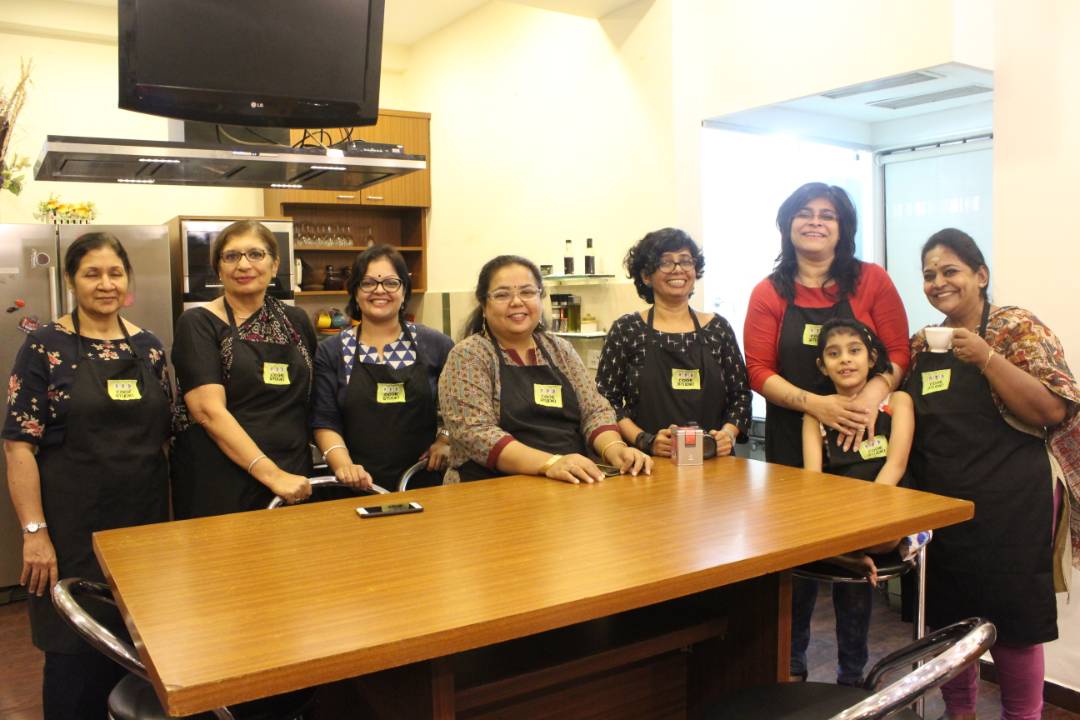
We congregated for a wonderful afternoon of pickle making to teach each signature pickles from our community cuisines along with a other pickle enthusiasts. On the menu were a Garhwali Hing Achaar by me, Sindhi ‘Bhendi’ pickle by Usha Auny, my sister in laws Mom, Maharashtrian pickle by my friend, Gujarati chundo by my Mom,  Vadu Mango by Geetha and a Bengali Mango chutney by my friend Rhea.  It was a beautiful day, we cut mangoes, mixed pickles, gossiped, ate ravenously and all took home with a share of 6 different pickles! We also learned new pickle recipes, which was the true exchange. 

I was only half serious when I said yes to Natasha, I didn’t think she would see it through (you know how kids can be, so easily distracted!). But she surprised me, willingly sticking by me every second of the day. And as we cut mangoes, mixed masalas, made pickles, talked and gossiped, she was right there, with me, little hands learning, struggling at some points to do adult things, but there, not giving up, even throwing in a few 9 year old jokes that had us all in splits! But, importantly she did it all. And every second of her being with me is magnified in my memories, larger than all the other memories of that wonderful day. Sweeter, more beautiful, most precious amidst all the other lovely moments. Lingering, as we made our way home that evening, carrying our bounty of pickles we had made.  But the truly defining moment was yet to come. 

Serendipitously, the Mango tree in my office complex was being harvested of its fruit at the time and Natasha wanted to watch so we stopped. And came away with a couple of the green mangoes from there as well. When we got home, I put everything away and did not give it further thought as I got on with dinner prep. 

Until the next day, when I came home to the moment in that picture. Natasha used the mangoes she got from the tree on our way home and made her very own batch of Hing ka achaar, grinding the hing, remembering the proportions and mixing everything just like I taught her. It was not perfect, but at that moment that didn't matter, she has a lifetime to perfect her recipe. What is importantis that she had made a family recipe. A recipe I had learned from her Dadi that she had inherited. And a tradition had been kept alive.

In the FB Live food chat on #AamAchaarDay, Saee pointed out that Indian pickles are as Artisanal as food can get. She is right. The term “Artisan” describes non industrial food, made in small batches by hand, by methods usually handed down through generations and often in danger of being lost. My paternal grandmother, Moti Mummy, made more than 90 pickles round the year, but I only inherited a handful of her recipes. My maternal great-grandmother is is said was an expert pickle maker too, her repertoire had some truly unusual pickles that I only have descriptions of. 

I don't mean to sound preachy, but if we are lucky enough to inherit family food traditions, they exist for a reason. And we owe it to ourselves and our kids to keep them alive. We must make our own pickles, even if its just a bottle or two. Having hands on made 10+ kgs of pickle this #AamAchaarDay we all realised it’s not so hard! Perhaps living away from family or alone in a city might make it difficult. But like me you can get together with friends and make a party of it! Or preparations might feel too hard. At one time, they might have been because everything would need to be done at home but not anymore! Our bhaji wallas and kirana stores have also evolved with us. Today one can get mangoes, whatever kind, prepped as we require, community stores stock ready masala mixes. It’s easy to put a batch of pickle together. Or if you must buy your pickles, buy from home chefs bottling pickles (store-bought pickles are RUBBISH compared to home made!). It is the only way to keep culinary legacy alive. And losing this legacy would be tragic.

And we must expose our children to our food culture. We owe it to our kids to pass food traditions on. The Mango pickles that flavor life’s memories for us in India are at home, made by our Grandmothers and Mothers. AND US now! And our children in the future! 

We all need to remember, that If our grandfathers planted mango trees for us to enjoy, our grandmothers pickled the fruit for us to savour. 

Gyaan and links 

Here are links to pickles from different community kitchens:
And my Ma in law's Heeng / Hing ka Achaar on my blog as well. 

If you have blogged recipes for mango pickles on your blogs, can you paste links in comments? Ill compile a comprehensive list of them. TIA!

An old painting of pickling mangoes I once made.